
Advertisement

Caltrops
Ling Gok

Published 1992
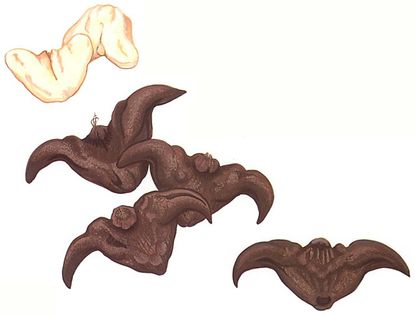
APPEARANCE: The bizarre shape of these nuts leaves no room for misidentification. They measure about 2 inches from tip to tip, with a smooth shell as hard as the horns they resemble. The inner nutmeat — as they are sometimes sold shelled — is also wing-tipped but creamy-white in color, as illustrated.
QUALITY: Unshelled nuts are difficult to evaluate. Choose those that look sound and smell fresh. When cracked, the meat should fill the inner cavity and be uniformly white.
COMMENTS: Three species of the genus Trapa have been providing human food since neolithic times. T. bicomuta, the species illustrated here, was an important staple in parts of China before the 20th century. T. bispinosa, the Singhara nut, also with two horns, is eaten by the people of Kashmir; while T. natans, the Jesuit’s nut, with four horns, is reported to have been a common food of ancient Europeans.