Advertisement
Knives and Their Uses

Published 2014
French knife or chef’s knife.
Most frequently used knife in the kitchen, for general-purpose chopping, slicing, dicing, and so on. The blade is wide at the heel and tapers to a point. Blade length of 10 inches (260 mm) is most popular for general work. Larger knives are for heavy cutting and chopping. Smaller blades are for more delicate work.
French knife or chef’s knife.
This is your most important tool, so you must learn to handle it and care for it well. Chapter 7 explains its use in detail.
Santoku knife or Japanese cook’s knife.
A wide-bladed knife that is often used as a substitute for the traditional chef’s knife. Blades are usually 5 inches (13 cm) or 7 inches (18 cm) long.
Santoku knife or Japanese cook’s knife
Utility knife or salad knife.
A narrow, pointed knife 6–8 inches (160–200 mm) long. Used mostly for pantry work, cutting and preparing lettuce, fruits, and so on. Also useful for carving roast chicken and duck.
Utility knife
Paring knife.
A small, pointed blade 2–4 inches (50–100 mm) long. Used for trimming and paring vegetables and fruits.
Paring knife
Boning knife.
A thin, pointed blade about 6 inches (160 mm) long. Used for boning raw meats and poultry. Stiff blades are used for heavier work. Flexible blades are used for lighter work and for filleting fish.
Boning knife
Slicer.
A long, slender, flexible blade up to 14 inches (360 mm) long. Used for carving and slicing cooked meats.
Slicer
Serrated slicer.
Like a slicer, but with a serrated edge. Used for cutting breads, cakes, and similar items.
Serrated slicer
Butcher knife.
A heavy, broad, slightly curved blade. Used for cutting, sectioning, and trimming raw meats in the butcher shop.
Butcher knife
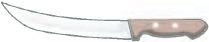
Scimitar or steak knife.
A curved, pointed blade. Used for accurate cutting of steaks.
Scimitar
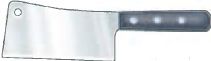
Cleaver.
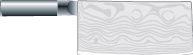
A heavy, broad blade. Used for cutting through bones. Do not confuse a cleaver with a similarly shaped Chinese cook’s knife, which is lighter in weight.
Cleaver
Chinese cook’s knife
Oyster knife.
A short, rigid, blunt knife with a dull edge. Used for opening oysters.
Oyster knife
Clam knife.
A short, rigid, broad-bladed knife with a slight edge. Used for opening clams.
Clam knife
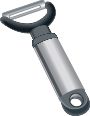
Vegetable peeler.
A short tool with a slotted, swiveling blade. Used for peeling vegetables and fruits.
Vegetable peeler
Swiss-style vegetable peeler
Steel.
Not a knife, but an essential part of the knife kit. Used for truing and maintaining knife edges (not for sharpening them—see Chapter 7).
Steel
Cutting board.
An important partner to the knife. Hardwood boards are favored by many chefs. Hard rubber or plastic boards are thought to be more sanitary, but there is some evidence that bacteria actually survive longer on plastic and rubber than on wood. Cutting boards must be kept very clean, and they must be sanitized regularly. Color-coded composite boards are designed to help reduce cross-contamination, as each color is used for a different category of food (for example, green for vegetables, red for meats).
Note: In some communities, wooden boards are prohibited by health regulations.