Advertisement

Measuring Devices
Appears in
Published 2025
The following equipment is discussed in terms of U.S. measurements. Comparable items in metric units are also available.
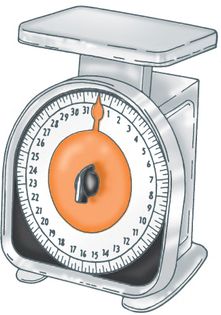
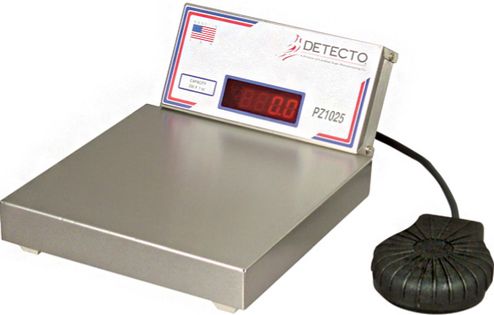
- Scales. Most recipe ingredients are measured by weight, so accurate scales are important. Portion scales are used for measuring ingredients as well as for portioning products for service. Traditional portion scales are spring-operated and usually have a dial to indicate weight. More accurate digital scales are electrically operated and provide a digital readout. The baker’s balance scale is discussed in Chapter 31.
Portion scale Digital scale
Courtesy of Cardinal Detecto
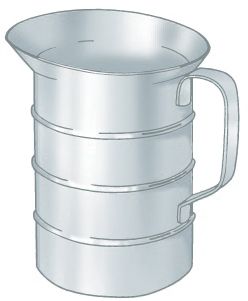
- Volume measures used for liquids have lips for easy pouring. Sizes are pints, quarts, half-gallons, and gallons. Each size is marked off into fourths by ridges on the sides.
Liquid volume measure - Measuring cups are available in 1-, 1⁄2-, ⅓-, and 1⁄4-cup sizes. They can be used for both liquid and dry measures.
- Measuring spoons are used for measuring very small volumes: 1 tablespoon, 1 teaspoon, ½ teaspoon, and ¼ teaspoon. They are used most often for spices and seasonings.
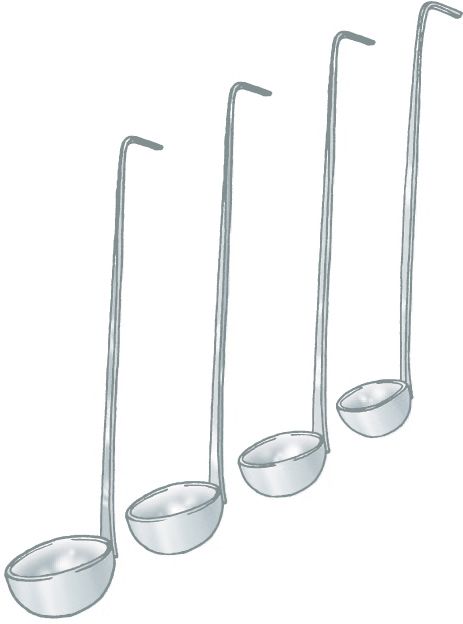
- Ladles are used for measuring and portioning liquids. The size, in ounces, is stamped on the handle.
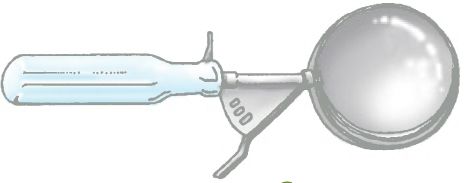
Ladles - Scoops come in standard sizes and have a lever for mechanical release. They are used for portioning soft solid foods. Scoop sizes are listed in Table 3.1. The number of the scoop indicates the number of level scoopfuls per quart. In actual use, a rounded scoopful is often more practical than a level scoopful, so exact weights will vary.
Scoop Video: Understanding Measurements
Table 3.1 Scoop Sizes
U.S. Measure Metric Measure Scoop Number Volume Approximate Weight Volume Approximate Weight 6 2⁄3 cup 5 oz 160 mL 140 g 8 ½ cup 4 oz 120 mL 110 g 10 3 fl oz 3–3½ oz 90 mL 85–100 g 12 ⅓ cup 2½–3 oz 80 mL 70–85 g 16 ¼ cup 2–2½ oz 60 mL 60–70 g 20 1½ fl oz 1¾ oz 45 mL 50 g 24 1⅓ fl oz 1⅓ oz 40 mL 40 g 30 1 fl oz 1 oz 30 mL 30 g 40 0.8 fl oz 0.8 oz 24 mL 23 g 60 ½ fl oz ½ oz 15 mL 15 g - Thermometers measure temperature. There are many kinds for many purposes.
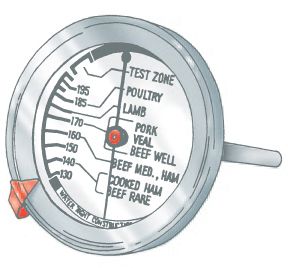
- A meat thermometer indicates internal temperature of meats. It is inserted before cooking and left in the product during cooking.
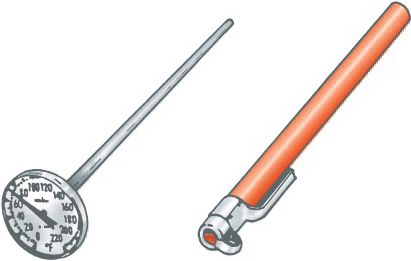
Meat thermometer - An instant-read thermometer gives readings within a few seconds of being inserted in a food product. It reads from 0°F to 220°F. Many chefs carry these in their jacket pocket like a pen, ready whenever needed. Instant-read thermometers must not be left in meats during roasting, or they will be damaged.
Instant-read thermometer with holder - Fat thermometers and candy thermometers test temperatures of frying fats and sugar syrups. They read up to 400°F.
- A digital infrared thermometer is a handheld device that uses laser beams to measure the surface temperature of foods and other items. It is useful because it works without touching the food, so is more sanitary. However, it can’t be used to measure the interior temperature of foods, such as roast meats.
- Special thermometers are used to test the accuracy of oven, refrigerator, and freezer thermostats.
- A meat thermometer indicates internal temperature of meats. It is inserted before cooking and left in the product during cooking.