Advertisement
A Stalk of Wheat
Appears in
Published 2004
- To fashion a stalk of wheat from pâte morte, take a piece of dough about the size of a large grape. Roll it briskly between your palms into a sphere. Place the ball onto the bench, and begin to elongate about 50 percent of it into a thin rope. This portion of the dough will become the stalk; the other 50 percent, as yet unrolled, will become the head of the wheat. Since the dough is on the dry side to begin with, don’t use dusting flour on the bench.
- Once the stalk section has been rolled out, begin tapering the remaining part of the dough into an elongated oval shape. Illustration A shows the progress to this point. Notice that the stalk remains quite thin right up to the neck of the wheat, where it then opens abruptly into the shape of the head. Next, take a thin-bladed knife and scribe 3 lines down the entire length of the head. The first line is made right down the center, with the other 2 on the near and far shoulder. Refer to illustration B for the correct spacing of the lines.
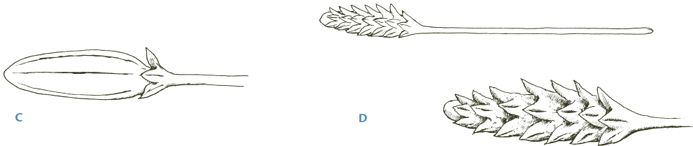
- A pair of scissors is used for the final step in fashioning the wheat stalk. Take a small snip of dough that bisects the middle of the 3 lines, close by the end of the wheat head where it tapers to the stalk. Take a second snip with the scissors, of the same size as the first, along the line on the far side of the dough. Then take a third snip in the same manner along the near side of the dough. Illustration C shows the progress to this point. Now return to the center line, and repeat the scissor cuts, first in the center, then on the far side, and finally on the near side, always aligning the scissors in the center of the scribed lines. Continue this pattern of snipping down the entire length of the dough. Illustration D shows the finished stalk of wheat and a close-up of the snipped kernels. Notice how the individual kernels are all bisected, just as they are in nature. It’s true that if you make a large display piece, using dozens of finely crafted wheat stalks, all carefully snipped, most people viewing it will not notice your subtle efforts at all, and with a quick glance just pass by. Noble art museums are little different; after an hour or two of gazing at great art, people can be heard saying, “oh, not another Vermeer” as they stroll off to the café.
A stalk of wheat