
Advertisement
Jellyfish
Appears in

By Ole Mouritsen and Klavs Styrbæk
Published 2017
As their name implies, jellyfish are a true gel. They are made up almost entirely of water, about 95 percent, with the rest consisting of 4 percent collagen and 1 percent protein, and very few carbohydrates. The collagen holds the body of the animal together. Some jellyfish contain toxins, but others, such as the common moon jellyfish, are quite edible. In many parts of Asia, including Korea and Japan, jellyfish are regarded as a great delicacy.
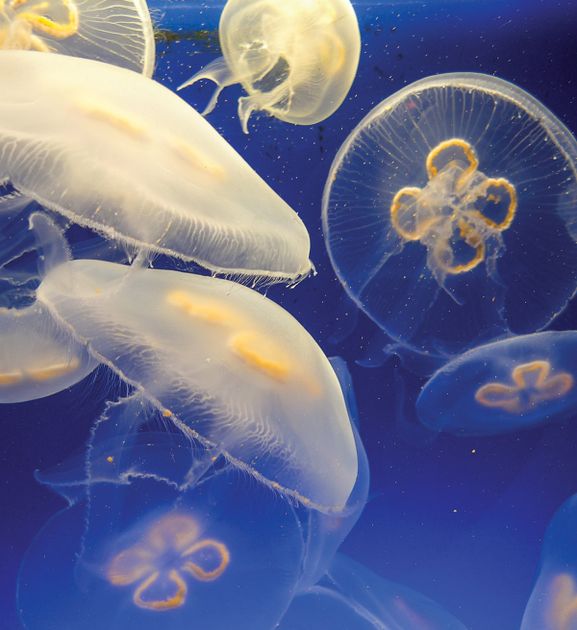
Jellyfish.
Jellyfish are among the few raw ingredients that are prepared and eaten almost exclusively on account of their mouthfeel. They have very little taste of their own, apart from saltiness, which is why they resemble artificial gels, even though they are much tougher. A freshly caught jellyfish will start to go off within a few hours and must be prepared right away. First, it is cleaned by removing the stomach, gonads, and various membranes, leaving only the bell and the tentacles that encircle the mouth. In Southeast Asia, jellyfish are usually preserved by drying them, either until they are completely dehydrated or at least until salting has caused them to lose 90 percent of their moisture.