Advertisement
Baking Equipment
By Keiko Ishida
Published 2010
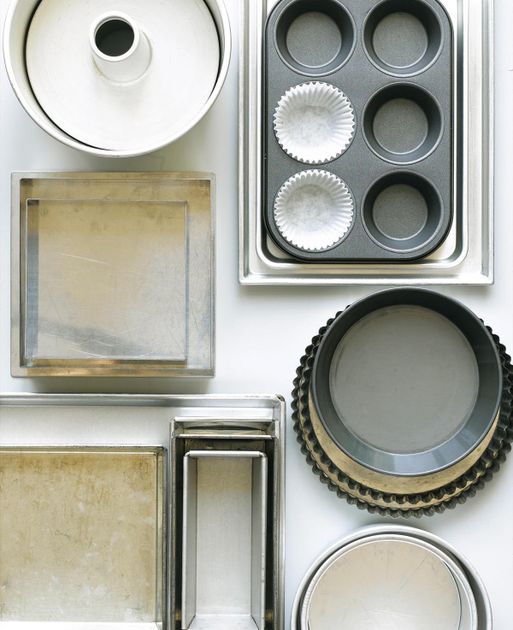
Chiffon cake pan or tube pan
This cake pan is made up of two aluminium pieces—an outer ring and a base piece that forms the bottom and the centre tube. It is not advisable to use a non-stick tube pan when baking chiffon cake.
Fluted tart tin with removable base
In my recipes, I often use tart tins that are either 20 cm or 22 cm in diameter. A tart or pie this size will typically serve 8–10 persons.
Muffin pan and paper muffin cases
My oven is quite small, so I use a 6-hole muffin pan instead of a 12-hole pan. That is why my muffin recipes only make 6 muffins, but you can always double the recipe to make more. I always use paper cases when baking muffins as this makes it easier to remove the muffins from the pan and to serve them.
Pound cake moulds
When baking pound cakes, you can use any type of pound cake moulds from those made of tin, aluminium or stainless steel. Take note however, that tin moulds absorb heat easily and will not be ideal if making chilled desserts such as mousse cakes and cheesecakes.
Round cake pan with removable base
Cake pans with a removable base allows delicate cakes to be removed easily. Select pans made of aluminium or stainless steel as they can be used for baking or chilling and do not rust easily.
Square cake ring without base
Cake rings are useful for making mousse cakes and cheesecakes. Use stainless steel cake rings as they are harder and hold their shape better than aluminium cake rings. Tin moulds tend to absorb heat easily and are not suitable for making chilled desserts.
Stainless steel or aluminium tray
Have these on hand to keep ingredients organised, to spread custard cream out for chilling or for placing under a cake rack when dusting with icing sugar or cocoa powder.
Swiss roll cake pan or sheet pan
A Swiss roll cake pan is a shallow square pan typically made of aluminium or stainless steel. For my recipes, I use a 28 x 28-cm pan.
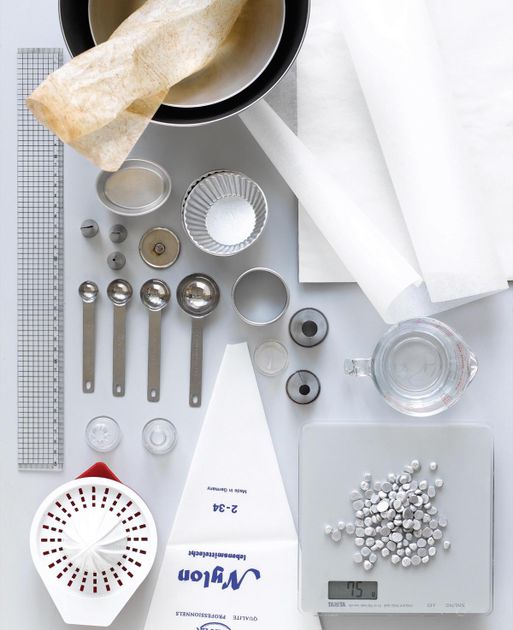
Flower nail
A flower nail is essential for piping flowers, leaves and other cake decorations. The key to making perfect buttercream or sugar flowers is to coordinate the turning of the nail with the formulation of each flower petal.
Metal cutters (plain and fluted)
I prefer using metal cutters to plastic ones, as I find that metal cutters give a cleaner cut which is important for pies and scones, as it makes them rise better. I recommend getting a boxed set that includes cutters in a range of sizes.
Measuring spoons
To measure small quantities of ingredients precisely, you must use measuring spoons. It is ideal to have a set made up of ¼ tsp, ½ tsp, 1 tsp and 1 Tbsp sizes. Note that 1 tsp = 5 ml and 1 Tbsp = 15 ml. Stainless steel measuring spoons are more durable than plastic ones which tend to retain food smells. When measuring dry ingredients such as salt and baking powder, be sure to level them off. When measuring liquids such as vanilla extract and liqueur, pour the liquids up to the edge of the spoon.
Mixing bowls
Stainless steel bowls are useful for recipes that require setting a bowl over hot or ice water since they have good thermal conductivity. They are easily washed and kept clean, and are very durable. I find the 23 cm bowls and 27 cm bowls very handy.
Oval cake pan, fluted tartlet tin and round tartlet tin
Small cake pans and tartlet tins are useful for making miniature treats. These pans are available in a variety of shapes at kitchenware shops.
Piping tips
14a Petal decorating tips: These are used for making flower petals. Choose the tips according to the size you want for your flowers.
14b Round, plain 10-cm and 15-cm tips: These are used for piping lines and balls of buttercream for cake decorations.
14c Star-shaped and St. Honore tips: Star-shaped tips can be used to make fancy decorations like stars, shell shapes and zig-zag lines. The St. Honore nozzle is a unique tip used to decorate St. Honore cakes, but can be used to pipe attractive designs on any cake.
Non-stick baking mat
Baking mats are heat-resistant, non-stick and reusable. Thick baking mats are best for making macarons as it helps even out the heat distribution. A thin mat can be used in the same way as parchment paper. I use it to line the tart tin when blind baking before adding aluminium weights. This helps ensure that the tart crust is kept even and flat.
Aluminium weights
Aluminium weights are reusable and can be easily washed and cleaned after use. When blind-baking tart shells, line the tart tin with aluminium foil or a non-stick baking mat, pressing well into the bottom corners, then add the baking weights. Other types of baking weights include ceramic weights, dried beans or rice.
Citrus juicer
A citrus juicer makes juicing citrus fruit very easy. Cut the fruit in half, then squeeze it on the sharp edge of the juicer to extract the juice.
Digital kitchen timer (not pictured)
If your oven is not equipped with a timer, invest in a good digital timer to help you churn out perfectly baked cakes.
Digital scale
Since precise measurements are very important in baking, I recommend using a digital scale. I prefer using a scale that has a minimum scale unit of less than 1 g and which can weigh up to 2 kg for home baking.
Measuring cup
Use clear measuring cups, preferably made of microwave-safe glass, so you can read the measurements at eye level and heat the liquid if necessary. I find it useful to have 2 measuring cups on hand, one in 250 ml and the other in 500 ml measurements.
Parchment paper and natural drawing paper
Parchment paper is used to line baking trays and cake pans. It is heat-resistant, non-stick and disposable. Natural drawing paper is the cheaper alternative to parchment paper, but it is not non-stick. I use these sheets to line my work surface so cleaning up is easier. I also sift flour onto parchment or natural drawing paper, so I can lift it up easily and pour it back into the mixing bowl.
Piping bags
Piping bags are essential for decorating cakes, and they are also useful for piping cake batter into small cake pans and mousse into glasses. Both disposable plastic piping bags and reusable cloth piping bags are available.
Ruler
A ruler is useful when you have to cut cakes into equal layers and measure mould sizes. I prefer using a plastic ruler that can be easily washed and kept clean. A 40-cm ruler is adequate.
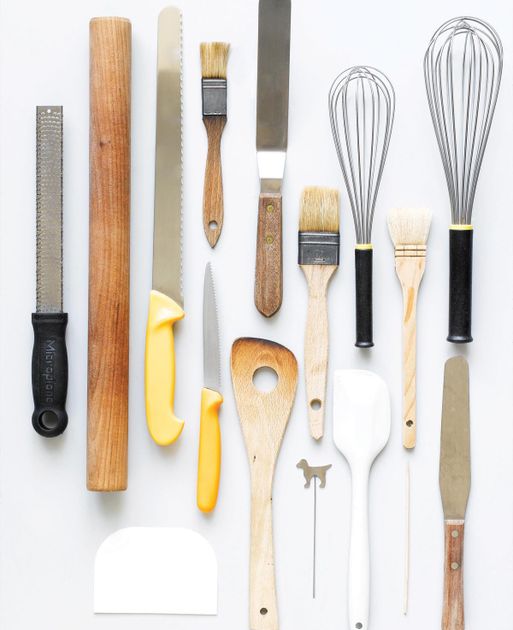
Grater
A grater can be used to zest citrus fruit like lemons, limes and oranges. Make sure that you do not grate the fruit too deeply, as the white part of the citrus fruit is very bitter. Graters can also be used to grate hard ingredients such as hard cheese, chocolate and nutmegs.
Offset spatula and straight spatula
An offset spatula (25a) is a palette knife with an angled blade. A straight spatula (25b) is a palette knife with a long, flexible metal blade. These spatulas are used to spread and smoothen batter evenly inside cake pans and spread cream on cakes in an even layer. Useful sizes to have are the 26 cm and 18 cm straight spatulas, and 20 cm and 11 cm offset spatulas.
Pastry brushes
A small brush (26a, about 2.5-cm width) is useful for buttering small cake pans and ramekins. A medium brush (26b, about 3-cm width) with natural soft bristles is handy for applying egg wash to cookies, pies and bread dough, and for brushing syrup on sponges and glazing jam on cakes. A big brush (26c, about 4-cm width) with natural bristles that are attached to the handle tightly is useful for brushing excess flour from pieces of rolled-out dough.
Perforated wooden spatula
When cooking liquids such as custard sauce and jam, I prefer using a perforated wooden spatula with a straight edge. The hole in the spatula makes it easier to stir the sauce or jam.
Rolling pin
Choose a wooden rolling pin that is slightly heavy. Its weight will help to flatten and push out dough while rolling it. A pin without a handle offers you the most control. My preference is for a rolling pin which is 45-cm long and 3.5 cm in diameter.
Scraper
The humble scraper is often referred to as a friend of the chef. This is a small but indispensable tool. I use it for cleaning floured tabletops, smoothing cookie dough, spreading sponge batter evenly in the cake pan and scooping up cream. Choose a hard plastic scraper.
Serrated cake slicer
A long slicer (30a) is very useful in slicing sponge cakes into layers and slicing bread without compressing it. A short slicer (30b) is handy for cutting fruit, nuts, tarts and cakes.
Silicone spatula
A silicone spatula is heatproof, which means you can use it to stir cake mixes as well as stir-fry ingredients. It is solid and long-lasting. I prefer using an integrated silicone spatula, which can be easily washed and kept clean, rather than a spatula with a wooden or plastic handle.
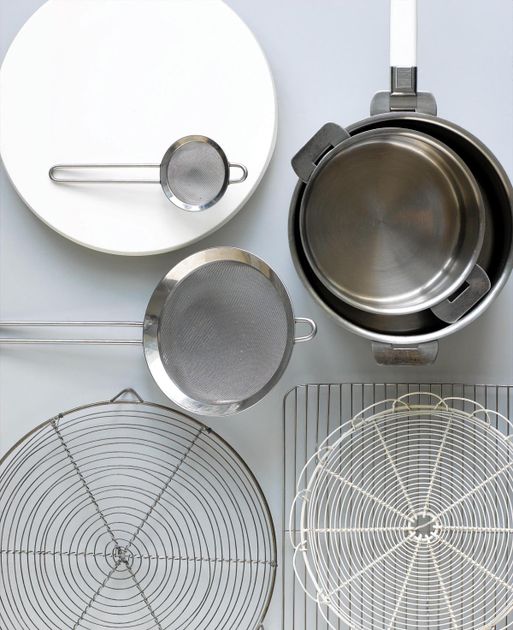
Decorating turntable
This is very useful when you need to spread the top and sides of cakes evenly with cream, and when applying decorations. A simple and small plastic turntable is good enough.
Saucepans
Use thick-based saucepans when cooking custard creams and sauces, syrups and jams. Saucepans that are at least 9-cm deep are ideal for stirring and mixing ingredients.
Cake tester and bamboo skewer
Test if a cake has been adequately baked by inserting a cake tester (34a) or bamboo skewer (34b) into the centre of the cake. The cake tester or bamboo skewer should come out clean.
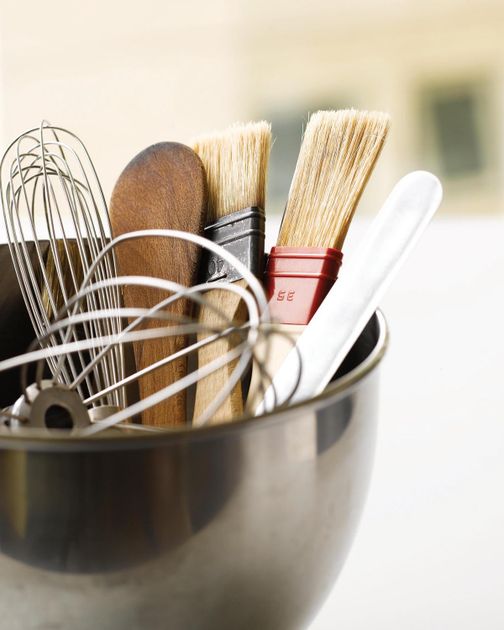
Whisks
Choose stainless-steel whisks with fine and solid wires. My preference is for 27-cm and 35-cm long whisks.
Wire strainers
Wire strainers can be used for straining liquids or sifting flours. I use a 16-cm diameter wire strainer (36a) for straining liquid mixtures and sifting flour, and a small wire strainer (36b) for dusting icing sugar or cocoa powder on cakes, pastries and other desserts.
Wire racks
Raised wire racks allow air to circulate around freshly baked cakes to cool them down. I find rectangular (28 × 43-cm) and round (30-cm diameter) wire racks most useful.
Blowtorch
A blowtorch is useful for unmoulding chilled cakes from cake moulds. It can also be used to caramelise Italian meringues and sugar on the surface of crème brûlées.
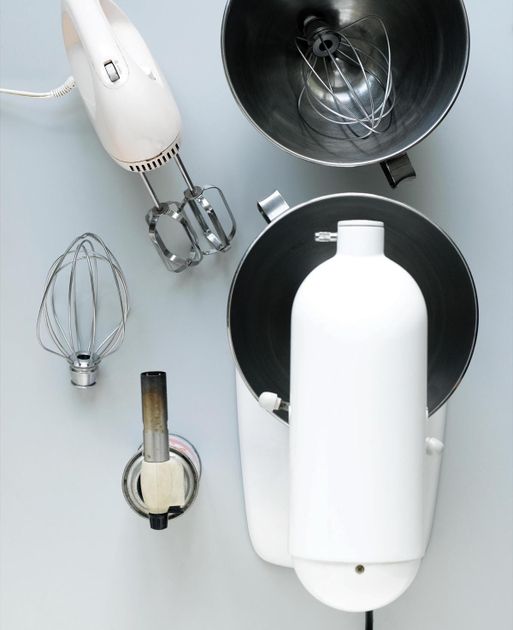
Electric cake mixer and electric handheld mixer
I can’t imagine baking without an electric mixer. There are two types of electric mixers: stand mixers (39a) and portable electric handheld mixers (39b). The handheld mixer is affordable and can be used when beating mixes over a double boiler. However, a handheld mixer has a lower power level than a stand mixer, so it will take longer to whisk or beat a mixture to the required consistency. Having both mixers handy would be ideal.