
Advertisement

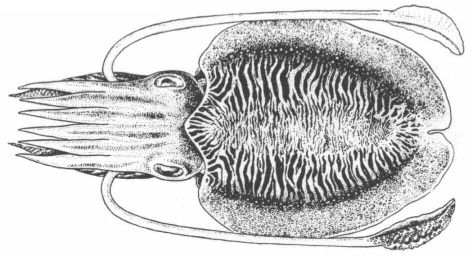
Cuttlefish
Sepia officinalis Linnaeus
Appears in
Published 1980
Family Sepiidae
- Portuguese: Choco
- Spanish: Jibia
- French: Seiche
- Dutch: Zeekat
- German: Tintenschnecke
- Swedish: Bläckfisk
- Norwegian: Sepiablekksprut
- Danish: Blæksprutte
- Icelandic: Smokkfiskur
- Other: Casseron (Charentes)
The cuttlefish is unusual among the cephalopods in that it is confined to the eastern Atlantic (north and south) and the Mediterranean. It is also unusual in having an internal ‘bone’ or shell, which used to be ground by druggists into tooth-powder but is now mainly used for exercising the beaks of pet birds. The ink of the cuttlefish was formerly used for making the colour sepia. Its ink is certainly abundant and pervasive, and one should try not to break the ink sacs if discarding them. Otherwise one risks a repetition of the cry in a play of Antiphanes (echoed by me to wife in our own kitchen when I first tackled a cuttlefish):