
Advertisement
V. Cooking Techniques and Kitchen Utensils

Published 2019
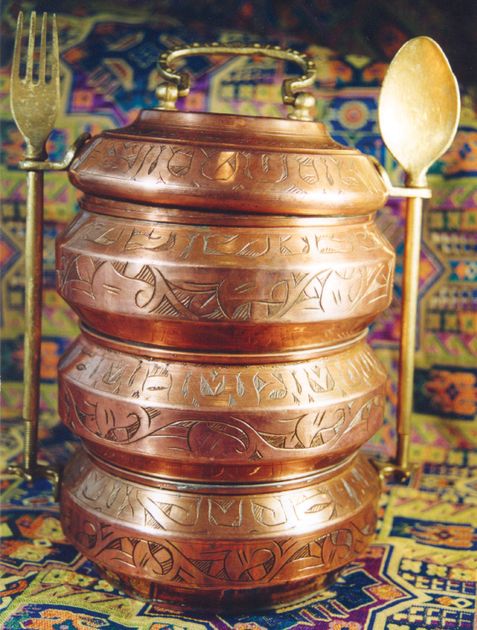
Traditional sufurtas (lunch box)
The ancient Mesopotamians exploited to the full all the major cooking techniques with which we are familiar today, even etymologically: ‘shuwu,’ roasting (Arabic shewi), ‘kababu,’ grilling on an open fire (cf. the universal kebab), ‘silqu,’ boiling (Arabic saliq), and ‘qalu,’ frying (Arabic qali), which also included toasting seeds in a pan.
In the realm of grilling over an open flame, they showed admirable mastery. To control the heat they put ashes or potsherds on the coals, kept the meat at a certain distance from the flames, or placed some sort of plate, rack, or screen made of metal or ceramic in between. They even used specific terms to describe the grilling process. Fish, for instance, was ‘placed on the fire’ (probably glowing coals) or was ‘touched with fire’ (Limet, p.139; Bottéro, The Oldest Cuisine). For those of us who grew up in Baghdad, such grilling options are quite familiar. Fresh shabbout or bunni fish is grilled in the masgouf style along the banks of the river Tigris. A number of these fishes would be suspended on sticks around the flames of a camp fire so that they were ‘touched by fire,’ and afterwards they would be ‘placed on the fire’. Skewered meat including locusts was grilled in the shish kebab style using braziers (Akkadian ‘kinunu,’ cf. Arabic kanoon). The ‘kinunu’ was a sort of all-purpose hearth made more versatile by using grills, skewers, and racks. Other types of hearth were either built up or dug out as a firebed, in a round or rectangular shape (Bottéro,