
Advertisement
VIII. Baghdad
Navel of the Earth

Published 2019
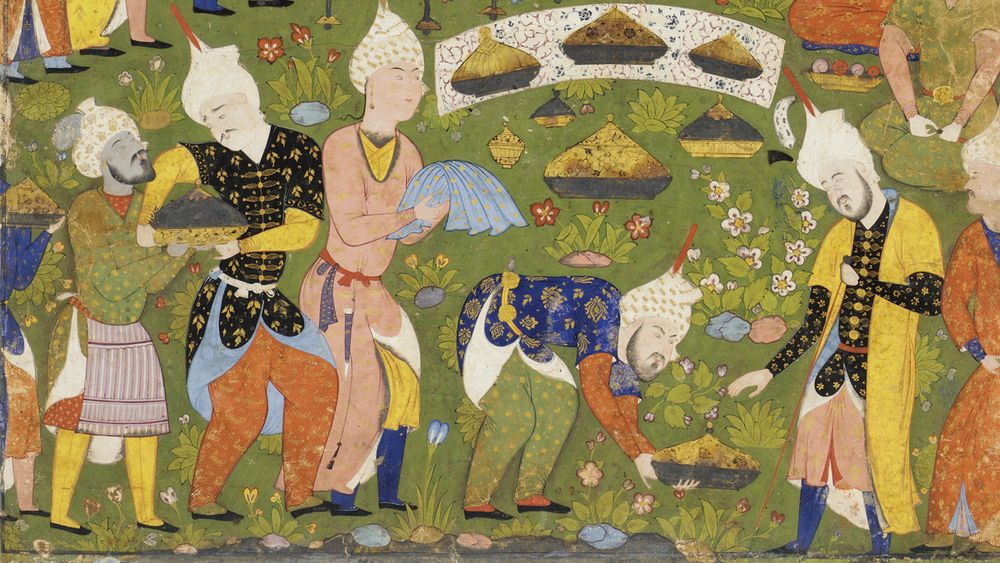
Cooks serving a grand meal
The geographer Yaqut al-Hamawi (d.1229) says that when the second caliph of the Abbasid family, Abu Ja’far al-Mansur (d.775), decided to build a new seat for the caliphate, a place called Baghdadu attracted his attention. It was a vibrant, thriving trading center or souq to which goods and provisions were brought from the four corners of the known world by land, river, and sea. Although it was referred to as qarya ‘village,’ it seems to have been teeming with life. He also quotes some of Ptolemy’s (d.c.168) topographical facts on Baghdad. The name was said to be of non-Arabic origin and stories differ on its meaning. Some say, for instance, it was composed of bagh ‘orchard’ and dad ‘gave’. One of the Arabic names chosen for the city was Dar al-Salam ‘the abode of peace’ (Mu’jam al-Buldan). Modern archaeological discoveries support al-Hamawi’s observation that part of the site of Baghdad was on the ruins of an ancient city, and that Baghdadu was an ancient Babylonian city, dating back to around 2000 bc.