Reem Assil

Reem’s

banner
Appears in
We Are La Cocina

By Leticia Landa and Caleb Zigas

Published 2019

  • About
Joined La Cocina: May 2014
In Oakland’s Fruitvale district, a corner bakery breathes color: freshly picked mint-green walls with Arabic calligraphy on one side, and turmeric-yellow walls with faces of Palestinian activists painted on the other.

In a room with white walls and blonde woods, Reem Assil shapes loaves of bread with strong hands, muscled and lean like any good baker’s. Her hands have not only kneaded dough; she has linked them with others’, held protest signs aloft, and raised a clenched fist, fighting for something better.

It wasn’t always obvious that Reem would end up cooking. The eldest child in an Arab home in the decidedly non-Arab Boston suburbs, Reem wanted to be exactly the opposite of what she believed society expected of her. She would not cook. She would not clean. If the elementary school kids would know her Arabness through the baklava her mother made and shared, then Reem would find another path to follow. But what path, when there are no models?

To be Arab in America has a pre- and post-9/11 dichotomy. On 9/11, Reem realized that her community was not trusted. She witnessed the mosque she had grown up in suddenly become a target not just of hate but also of the American government’s search for answers. Before 9/11, her father was an engineer working for a company that required national security clearance. After 9/11, his security clearance was revoked without explanation, forcing him into retirement. Before 9/11, the only Arab country that her school friends had heard of was Lebanon. Now it would be Afghanistan (not even an Arab country, despite the perception) and Iraq. It would be the Middle East, and, for once, that would mean something.

Reem, who grew up on a mixture of muhammara and macaroni and cheese at home. Reem, whose mother had left Lebanon—where she couldn’t be a Palestinian—for a place where she wouldn’t feel like an outsider. Reem, still looking for that place when she left college, joined her father on a trip to Syria, tracing the foodways that had brought him to America in the first place; the Arab street and corner bakeries inspired her. Communities came together around the warm ovens. They gathered, and people made space for them.

For several years before she started her business, Reem had been building community. Living with a food-obsessed uncle and aunt in Daly City after college had introduced Reem to the landscape of the Bay Area’s food scene. During the day, she climbed the ranks as an organizer, primarily working with airport service workers who had been fired post-9/11, forced to reenter the market as subcontractors. But something was always missing for her in that work. A void between the immediacy of community connection and the opacity of policy work. She was organizing, but she didn’t know what she was building.

When Reem stands in her bread room, looking out at Fruitvale, her hands making deep indentations into the kneaded dough for her man’oushe, you can feel the power in the way the bread doubles over, sinks back down, rises back up. You feel it in Reem’s determined gaze, in her focus. Later, after the dough rises again, it will be portioned and proofed. Reem, along with her team, will fire up a sajj—a Lebanese cooking tool like an inverted wok with high heat under the surface. Using a big round pillow, the cook places a flattened round of dough, then quickly turns it over and smacks the dough onto the hot sajj. When the cook lifts the pillow, the dough springs away and immediately begins to rise, with a little steam escaping from the sides. The cook flips the bread, spreads glistening Californian olive oil across the surface, and rains down za’atar, specks of green, yellow, and off-browns on the bread’s taut canvas.

Customers across the Bay Area line up for Reem’s food. Community organizers in the East Bay come to her restaurant. Curious shoppers and waves of tourists line up at the sight of fresh bread at the Ferry Building farmers’ market on Saturdays. The man’oushe comes off of the sajj, and Reem adds cut tomato, fresh herbs, and avocado before rolling up the bread and calling out her customer’s name.

The sign above her farmers’ market stall reads “Arab Street Food.” Reem feels the most Arab when she is around her food, at the very moment the bread comes off of the sajj. But ask her when she feels the most American, and there is a long pause, and “I don’t know.” It’s an answer filled with uncertainty, an unfamiliar emotion in Reem’s world.

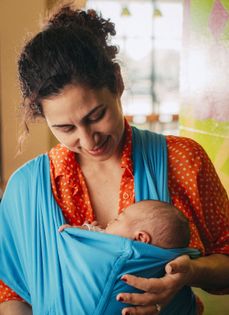
Reem knows there is no other homeland that she is likely to return to. This is it. This is where she lives, works, and dreams. This is where she married a child of Filipino immigrants from a social-activist soccer league who converted to Islam to better know her family, and this is where they will raise their child. The man’oushe has her Arab roots baked into every fold, and is covered in undeniably Californian ingredients. It is neither exclusively of one place or the other, but it is certainly delicious.